From Findings to Transformation: Turning Internal IT Self-Assessments into Strategic Wins
You’ve scoped it. You’ve executed it. Your internal team has surfaced real gaps, inefficiencies, and opportunities. Part 3 of a 3-Part Series on Building a Self-Assessment Strategy That Works
Mohi Jargboh-Sillah
6/8/20254 min read


Thank you for joining me on this journey over the last few weeks.
This is the third and final part of our three-part series on launching internal IT self-assessments in Life Sciences, but it’s far from the end when it comes to growth, transformation, and what your team can achieve.
You’ve scoped it. You’ve executed it. Your internal team has surfaced real gaps, inefficiencies, and opportunities.
Now what?
Welcome to Part 3 of our Life Sciences IT Self-Assessment series. In Part 1, we covered why internal self-assessments are a strategic advantage. In Part 2, we showed you how to run one without burning out your already stretched team.
Now we close the loop with the most critical step: Turning what you learned into action, funding, and lasting transformation.
Because a self-assessment that sits in a shared folder isn’t strategy, it’s a missed opportunity.
1. Distill the Story: Turn Data Into Narrative
Stakeholders don’t need a data dump; they need clarity. The first step is translating your findings into a story:
What did we discover?
Why does it matter?
What’s at risk or at stake?
What do we recommend next?
Tip: Keep it simple. Summarize in 1–2 pages. Use categories like Quick Wins, Strategic Risks, and Audit Red Flags. Pair your narrative with charts or screenshots to make the message concrete and digestible.
2. Prioritize Actionable Work
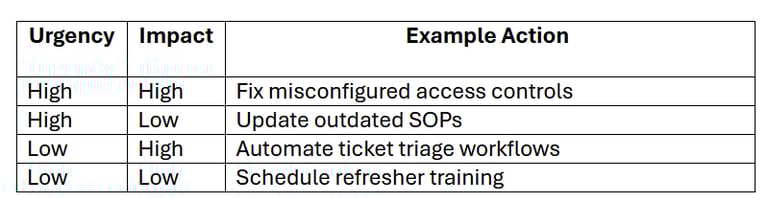
You can’t (and shouldn’t) fix everything at once. But you do need momentum.
Use a simple matrix to prioritize:
Target 1–3 quick wins in the first 30 days. Fast progress builds credibility and makes future investment conversations easier.
3. Build the Business Case
Some improvements need resources. To win support, frame your proposal like an executive does:
Align with business goals “This helps us pass GxP audits faster and reduce documentation rework.”
Quantify risk “This unresolved system gap increases the chance of data integrity violations.”
Show value “Automating this workflow frees up 12 hours/week of analyst time.”
Your self-assessment data isn’t just insight, it’s leverage.
4. Engage Cross-Functional Partners
Internal assessments aren’t just IT’s responsibility; they’re an opportunity for cross-functional alignment.
Bring in:
Quality & Compliance – To prioritize GxP findings
Risk & Security – To address vulnerabilities
Procurement – If new tools or vendors are needed
Business Unit Leaders – Especially when findings affect operations
Use the self-assessment as a neutral starting point. “Here’s what we found. What would it take to solve it together?”
5. Create a Roadmap That Scales
A solid self-assessment deserves a place on your strategic roadmap.
Segment your findings into:
0–3 Months: Quick fixes & low-hanging fruit
3–9 Months: Funded projects & team process upgrades
9–18 Months: System modernization or cross-departmental changes
Use this roadmap to guide budget planning, stakeholder alignment, and capacity allocation.
Bonus: Link action items directly to your project or ITSM platforms (e.g., Jira, ServiceNow, Asana) to track progress and maintain accountability.
Once the roadmap is in place, leadership can make an informed decision on who should drive the transformation:
Empower the in-house team to own and execute improvements
Engage external consultants for industry-specific alignment or independent validation
Bring on temporary support to augment capacity while keeping execution internal
What matters most is that execution doesn’t stall, and that those closest to the systems remain actively involved in shaping the future.
6. Close the Loop, And Celebrate
Your assessment shouldn’t end in silence.
Make sure to:
Share what’s been addressed
Communicate progress to leadership
Acknowledge team contributions
Identify what’s still ahead
And yes, celebrate. No matter how tight the budget, find a way to mark the moment. Take your team out for lunch, bring in pizza and fruit, or simply host a short “look what we did” huddle.
“In one of our assessments, we wrapped up a sprint with a shared lunch and reflections. It wasn’t about the food, it was about pausing to appreciate what we accomplished together.”
Small celebrations build big loyalty. And people commit to what they feel connected to.
Remember: the effort is important, but so is the pause to say, “Well done.”
Final Thought: Turn Insight into Influence
The best internal self-assessments don’t just identify issues; they position IT as a strategic force in the business.
When you act on what you find, you:
Reduce audit risk
Strengthen performance
Build trust across teams
Shape the roadmap, not just follow it
So don’t let your insights gather digital dust. Turn them into action. Turn them into impact. Turn them into trust.
In Case You Missed It:
This wraps up our 3-part series on high-impact internal IT self-assessments in the Life Sciences industry:
You are here: From Findings to Transformation
Have you led or participated in a self-assessment that led to real change? I’d love to hear what worked; and what didn’t.
With experience at the intersection of IT operations, compliance, and user-centered support, we have seen how thoughtful service strategies can reduce friction and accelerate outcomes—especially in high-stakes environments like life sciences and higher education. It’s always rewarding to partner with teams committed to improving workflows, modernizing systems, and delivering real value to their end users.